Found a new cheese vendor yesterday who had some really interesting stuff.
This was at one of my favorite markets, Caussade every Monday. Yesterday being both August and part of a 4 day weekend in France the market was really really crowded. Great fun though & with everything coming into season the shopping was incredible.
Anyway, I noticed a cheese stand that I'd never stopped at before. Wow! 20 Euros later I left with what you see below: 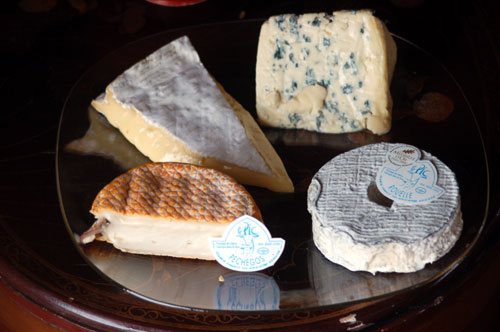
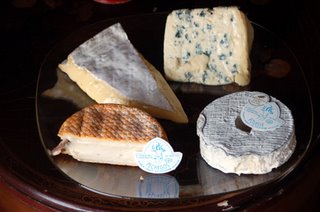 Two of the cheeses, the brie de mieux (perfectly ripe) and the St Augur blue (one of our favorites even if it is a 'factory' cheese.) are pretty standard stuff. The other two & the fifth cheese not in the picture aren't. So here's some detail.
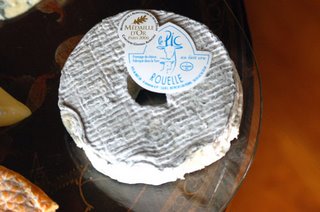 As you can see the cheese is called Rouelle, its raw goats milk & comes from the Tarn (just South of us.) It looks very similar to the cheese Bleudauvergne posted on eGullet.. Don't know if its the same or just that thry're both the same shaped & ashed. In any case its mild, slightly chalky in texture and a little different from most chevres.
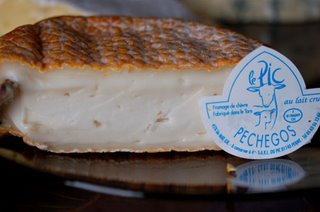
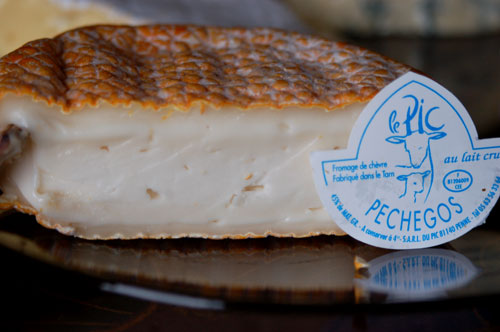
This one is called Pechegos. Another raw milk goats cheese, but with an entirely different taste. Much stronger and a very creamy texture. Note that they're from the same maker, "Le Pic". Questioning revealed that this is a cooperative down in the Tarn; quess where I'm heading soon.
The real gem, however, is pictured below. This is Bouysset chevre. A raw goat's milk brie! I'd only ever found this cheese once before & even this time it was not labeled. The seller wouldn't say where he got it from, but he did say that it was only made at the height of summer.
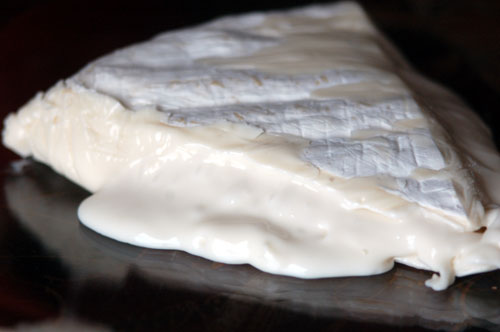
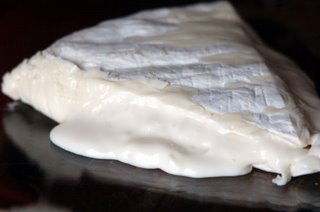
It tastes wonderful, like a brie, but at the same time not like a brie. Sort of hard to describe. I can tell you that our dinner guests made short work of it. Sharing is hard sometimes.Living in France is so hard.
Ps:See next post for a description of dinner.
A while ago we wanted to put in a new kitchen. After a lot of looking we hadn't been able to find kitchen cabinets that we both liked & could afford. We got a tip on buyng standard IKEA kitchen cabinets then taking the doors back for a refund. You then could buy custom doors made or have them made. This started a new hunt. The doors you could buy were OK, but the quality wasn't much. Jacques to the rescue!
He had a friend who would make kitchen cabinet doors for us. Enter Gerard! Gerard showed us all kinds of different woods he could use plus a number of door designs. After much thought we choose some light oak as the wood & a fairly traditional design. Gerard then gave us a final 'devis' or quote. A good price & we'd saved a lot of money overall.
True to his word & schedule Gerard started showing up to fit the doors. His level of craftmanship was astoundingly good. As is our practice we gave Gerard lunch while he was with us. (our theory being that if the artisans stay on premises for lunch it will be shorted & more work will get done. In any case its good for our French.) As we got to know him it turns out that Gerard's true love is his falcons & hunting with them. The cabinet making is merely a means to make enough money to live on.
Gerard started bringing us small food presents. One time it was hare pate made from wild hare that his falcons had caught & that Gerard had made. Another time it was squab stuffed with fois gras. The falcons, again, having caught the squabs. Yummy stuff & a good friendship developed.
Just as he was finishing the kitchen (by the way he did a superb job, on time & on budget) he tols us that his male falcon had badly injured one of his talons & that it had become infected. This could have been a real tradegy as without a talon the falcon can't prech properly ot catch prey. Fortunately we had a tube of antiseptic cream from the states that isn't available in France. We gave this to Gerard & it did the trick. The falcon healed quickly & was as good as new.
So, if you want great cabinet making just find your Gerard & you may get a real bonus as well.
By the way we did go to visit the falcons & they are truely beautiful. Gerard's house is so far out into the hills that you need a diving rod to find it. Its nice to meet a truely happy man living the life he wants.
I first posted this on eGullet in answer to a question, but I thought I may as well put it on the blog where people can get at it all the time. Next time I do it I'll take some pictures to add.
Lamb is my favorite meat & I've been cooking legs for many years. Here's a pretty much fool proof method that always wows even the non-lamb lovers.Start in the morning of the day you're going to serve the lamb.1) read the eGullet culinary institute course on slow cooking meats. 2) Debone the leg end, but leave the shank end as is. This helps both the cooking & the carving.3) Salt, pepper, a little minced garlic & a little rubbed rosemany should be placed in the boned cavity. Then tie the boned portion back togetherr with kitchen string.4) cut 3-5 slashes about 1/2 inch deep across the outside leg end on a diagonal. In each slash place an salted tinned anchovy. (Never fear, they add a great flavor & your guests can have a great time guessing, mostly wrongly, what your secret magic ingredient is.) Add a generous amount of freshly ground pepper & some more rubbed rosemary leaves. NO salt as the anchovies take care of that.5) Here's the only tricky part. Pre-heat an oven to 425 F. Put the lamb in for about 20 minutes to brown. Take the lamb out of the hot oven & place it in an oven at 160 F. The tricky part is getting both temperatures. If you have 2 ovens then you're in great shape. If not then just let the browned lamb rest while you get the oven temperature down to 160 F. DO NOT leave the lamb in while the oven cools down; it will cook too fast.6) Roast at 160 F for 7 hours. Once you reach 61/2 hours timing is no longer important. Anothe hour or even more will be Ok. This makes life much easier when it comes to bringing the meal together.7) Let the lamb rest out of the oven for 15-20 minutes before carving. As an option (but one your guests will love) make a gravy. Carefully pour off most of the fat, but not all, from the roasting tin. Then put the roasting tin over high heat on the stove. Deglaze with a good dollop of red wine. Make sure you scrape all the bits off the sides & bottom. Let boil until the wine is reduced to 1/3 of its original volume. Take the tin off heat & as soon as it quits boiling add lots (8-12 oz) of heavy (35%) cream. Back on heat stirring constantly. Reduce to about 2/3 rds of original volume. Pour gravy into a sauce boat & enjoy.Lamb done this way is absolutely delicious & has the great advantage of simplicity.Don't know what you're serving with it, but a couple of recommendations are:Roast ratatouille & roast potatoes cooked in duck fat with Herbs de Province & lots of sea salt.STORY: Last time I served this & there were 10 of us; the guests at one end of the table used up most of the gravy. (they'd had it before) not realizing that that was all there was for everybody. Fortunately Tom who is a professional chef was there. He & my wife went back to the kitchen & whipped up more gravy using olive oil, red wine, lamb stock cubes, some leg trimmings & more cream. It was amazingly good all things considered & our guilty guests were saved. Everybody wanted to try the 'concoction', but the guilty paries weren't allowed. Great party!
 Two of the cheeses, the brie de mieux (perfectly ripe) and the St Augur blue (one of our favorites even if it is a 'factory' cheese.) are pretty standard stuff. The other two & the fifth cheese not in the picture aren't. So here's some detail.